
Monday Musings #133 🤬
Why I’m starting 2026 with a table instead of a checklist
Good Monday, Gamer!
“Begin at the beginning,” the King said gravely, “and go on till you come to the end: then stop.”
— Lewis Carroll
Welcome to the
This is usually the moment when we’re supposed to arrive with lists.
Resolutions. Goals. Declarations.
A confident stack of games we must play this year, systems we’ll finally commit to, campaigns we’ll definitely finish. I thought I’d have that list ready.
Turns out I don’t. Not really.
What I do have are premises I’d like to play with. Genres. Moods. Questions I want to explore at the table. And instead of forcing myself to reverse-engineer those into a rigid “play this, not that” plan, I’m leaning into a different approach: start with the fiction I want, then see which systems actually support it and run that.
Running Monster of the Week has already kicked that door open. It’s got me thinking that revisiting Liminal and Urban Shadows might be in order—maybe even a comparison piece down the line. The big, beautiful, ambitious games are still there, too. Ars Magica. Invisible Sun. Nobilis. They loom the way they always do. Important. Demanding and waiting for the right season.
But right now? Daddy’s got a brand-new IRL regular group.
And that might be the real resolution: keep this IRL table alive as long as I can in 2026
What’s on your gaming list this year?
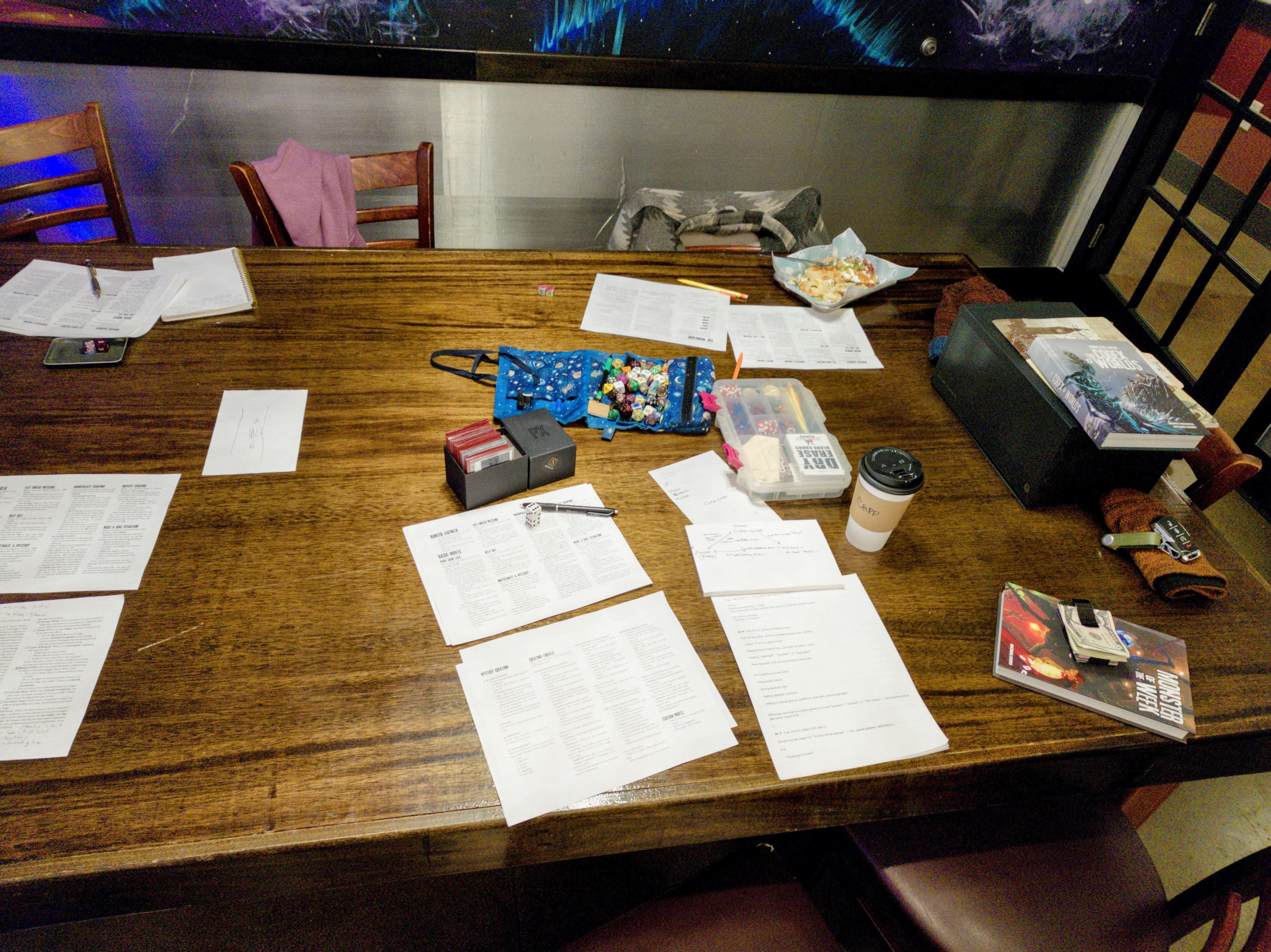
Monster of the Week: Kansas City
I kicked off a new Monster of the Week campaign this week, IRL, with a local group at my favorite game café here in the Kansas City metro. I went all-in on the private, sci-fi-themed room. Cardboard Corner Café’s main floor gets loud—not in a bad way, just in the way a popular, well-loved gaming space does. Tables full. Dice rolling. People laughing. But for a new group, and for a game that lives and dies on conversation, I wanted space where we could hear each other.
The Hunters
We’ve got a small but sharp crew:
Eleanor, playing The Flake
Michael Lewis, playing The Mundane
Blake, playing The Curse-Eater
What worked immediately was how entangled these characters already were before the first mystery even properly began. Monster of the Week’s History mechanics do a lot of heavy lifting here, and the table leaned into that hard.
Eleanor and Blake attend the same very mundane support group meetings. Michael Lewis and Eleanor are cryptozoology nerds, deep enough into fringe research that long conversations and late-night rabbit holes are just part of the relationship. Michael often drives Eleanor places—one of those small, practical details that ends up doing a surprising amount of narrative work.
Blake is the pivot point. He once rescued Michael Lewis from a siren’s call, unintentionally dragging him across the veil and into the occulted world. Michael didn’t go looking for monsters—but now that he knows they exist, he can’t unknow it.
All of this emerged naturally in play, not as a lore dump. That’s where Monster of the Week—and PbtA more broadly—really shines.
For folks unfamiliar with it, Monster of the Week is the occulted episodic genre RPG: Centering on a mystery. A threat appears. Clues accumulate. Pressure escalates. Eventually, the hunters confront whatever’s lurking just beyond normal life. It’s a Powered-by-the-Apocalypse system, so it’s not about turn-taking or tactical positioning. It’s about conversation. The rules step in when the fiction demands uncertainty or consequence—not when someone’s “turn” comes up. Characters are defined by playbooks that encode genre roles: the skeptic, the expert, the weirdo, the normal person who got pulled in too deep.
The First Mystery
We set the game in our own Kansas City metro area. Familiar streets and places. That choice always pays off faster than inventing a city from whole cloth. While en route to their support meeting, the team happens—happens—upon a bus accident. Emergency responders are already on scene. Efficient. Calm. Professional.
Almost too professional.
Something about them is just… too shiny. Their uniforms are close enough. Their procedures are close enough. But too perfect and not quite right. When an accident scene is being managed so smoothly that traffic never stalls, alarms start going off—fictionally and otherwise. This was a first session for two of the players new to PbtA, and you could feel the recalibration happening—not confusion, just adjustment. Letting go of initiative. Trusting the conversation. Learning that the game isn’t asking “what do you do on your turn?” but “what do you do now?”
And then there’s the move.
Man, I love “Read a Bad Situation.” Watching the group negotiate questions, pull imperfect answers, and act on incomplete information was a complete joy.
Closing the Session
We wrapped with more questions than answers, but plenty of leads. Everyone left knowing what kind of show we’re playing, how their characters connect to each other, and that Kansas City might be a little less safe than it looks.
It felt good to be back at the real table again.
ICYMI
Roll for Origin Five episodes in now with Lowell — digging deep into supers history:
And also Lowell Francis and Marc Majcher, talking post-apocalypse:
Roll for Mutation
A sharp bit of wisdom from Keith Senkowski
And a new format worth checking out from Indie RPG Newsletter